
10x More Efficient Than Rote Memorization: Unveiling the Cornell Note-Taking Method and Ebbinghaus's Forgetting Curve (with Free Templates)
Have you ever experienced this: taking meticulous notes during class, feeling like you understood everything at the time, only to find it all vanished from your memory two days later? Or, for an important exam, you go over the entire textbook repeatedly, yet the key points remain a blurry mess in your mind?
If these scenarios sound familiar, you might be trapped in the "inefficient diligence" pitfall. I was once a "victim" of this trap during my college years. To pass a dense Theoretical Physics course, I handwritten three notebooks' worth of notes and stayed up all night for a week before the exam. The result? I barely passed, and the knowledge I had "memorized" evaporated the moment the exam ended.
This frustration led me to reflect: the problem wasn't a lack of effort, but the method of learning. Fortunately, I later discovered two powerful learning tools—the Cornell Note-Taking Method and the Ebbinghaus Forgetting Curve. They completely transformed my learning trajectory, turning me from a student who relied on rote memorization into an efficient builder of knowledge systems.
Today, I want to share these two "secret weapons" with you.
The Art of Organizing Thoughts: The Cornell Note-Taking Method
The Cornell Note-Taking Method was developed by Walter Pauk, an education professor at Cornell University. It’s designed to help students record, organize, and review notes more effectively. It’s not just about recording; it’s an active thinking process.
The core of this method lies in its unique page layout. A single sheet is divided into three areas:
- Notes Area: The largest section, used for recording class content, reading notes, etc.
- Cues Area: The narrow section on the left, used for distilling keywords, questions, or main points.
- Summary Area: The section at the bottom, used for summarizing the entire page's content in your own words.
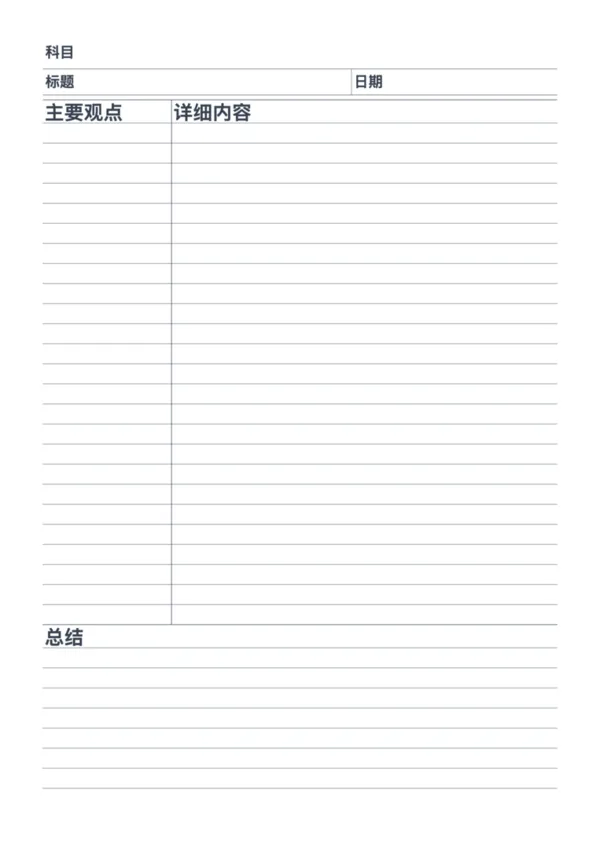
Generate printable Cornell Notes with a dedicated header for subjects, topics, and dates. Perfect for students, meetings, and academic research. Download your custom PDF instantly.
How to Practice the "5R" Steps?
The essence of the Cornell method lies in its five steps, known as the "5R":
- Record: In the Notes Area, take notes as you normally would during a lecture or while reading, but try to use concise sentences and abbreviations to capture core ideas. Don't aim for perfection; focus on keeping up with the flow.
- Reduce/Question: As soon after class as possible, review the Notes Area and distill key questions or cue words in the Cues Area on the left. This process is the first step in forcing yourself to think, "What is the point of this information?"
- Recite: Cover the Notes Area on the right, look only at the questions or keywords in the Cues Area, and try to recite the notes in your own words. This is the key to testing whether you truly understand.
- Reflect: Take some time to think deeply about the notes. "How do these points relate to each other?" "What are the real-world applications?" "Do I agree with this viewpoint?" Reflection turns "someone else's" knowledge into "your own."
- Review: Spend 10 minutes every day quickly browsing your notes, especially the Cues Area and Summary Area. These short and frequent reviews greatly consolidate memory.
I first applied this method in an elective "History of Western Art" course. Faced with a vast number of names, movements, and timelines, I stopped simply transcribing and instead constantly asked questions in the Cues Area: "What are the core characteristics of this movement?" "Why was this artist unique?". During final exam prep, I almost only looked at the Cues Area and Summary Area, and my study efficiency increased several times over.
The Science of Fighting Forgetfulness: The Ebbinghaus Forgetting Curve
You might not know Hermann Ebbinghaus, but you have certainly experienced the "Forgetting Curve" he described. Simply put, the new knowledge we learn, if not reviewed, is forgotten quickly at first and then more slowly. After one day, you might have forgotten more than half.
The Ebbinghaus Forgetting Curve isn't a single method, but a set of review strategies based on the theory of the "Forgetting Curve," with its core being Spaced Repetition. This means reviewing knowledge at the critical point when it's about to be forgotten, achieving the strongest memory effect with the least amount of time.
A classic recommended review cycle is:
- Day of learning
- Day 1
- Day 4
- Day 7
- Day 15
- Day 30
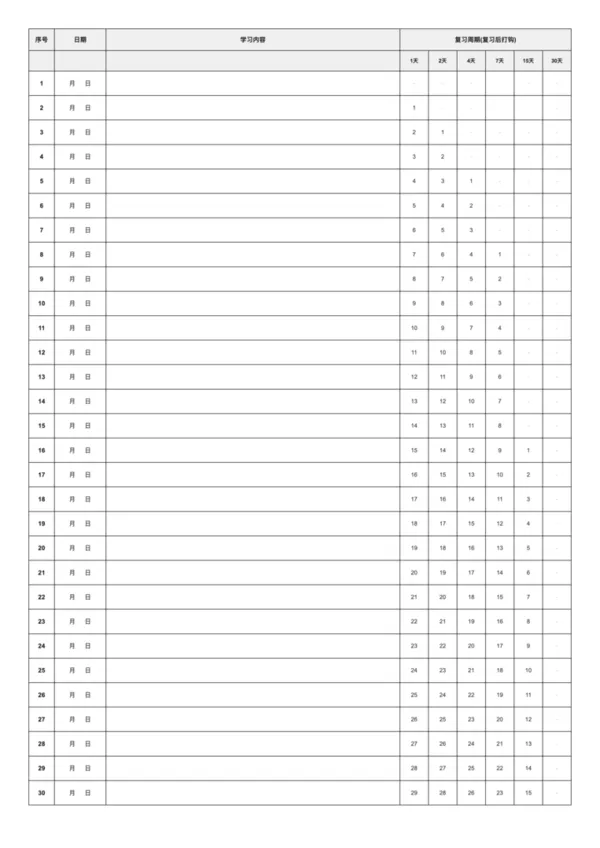
A 30-day learning and review template based on the Ebbinghaus forgetting curve, helping you scientifically schedule review times and improve memory efficiency. Includes six review cycles: 1, 2, 4, 7, 15, and 30 days.
How to Integrate Ebbinghaus into Daily Life?
Years ago, while preparing for the GRE exam, I was faced with thousands of obscure English words. Initially, I memorized 100 new words every day, but I would forget 80 of them the next day, which was extremely frustrating.
Later, I started using the Ebbinghaus method. I created a review schedule where each day's task was divided into two parts: learning new words and reviewing what I had learned before. For example, on Day 15, I needed to learn 100 new words while also reviewing the words I had learned on Day 14, Day 11, Day 8, and Day 1.
Although the workload seemed to have increased, a miracle happened. Because it was spaced repetition, each time I reviewed, the words that were "about to be forgotten" were reactivated, and the memory became increasingly solid. After two months of using this method, I had mastered far more vocabulary than expected.
A Powerful Combination: When Cornell Meets Ebbinghaus
These two methods are powerful individually, but combined, the effect is stunning.
My practice flow looks like this:
- During class/reading: Use the
Cornell Note Templateto record and organize information. - After class: Complete the "Reduce," "Recite," and "Reflect" steps of the Cornell notes.
- Set a review plan: Treat the Cornell notes completed that day as a "learning unit" and register it in the
Ebbinghaus Forgetting Curve Template. - Execute the review: Every morning, I first check the Ebbinghaus table to see which "learning units" need to be reviewed today. During review, I mainly use the Cues Area and Summary Area of the Cornell notes to quickly recall the core content.
This system helps me set an "automatic reminder" alarm for every piece of knowledge, ensuring they settle into long-term memory.
Conclusion
Learning is not a one-time sprint, but a marathon that requires strategy and endurance. The Cornell Note-Taking Method teaches us how to think deeply and organize information, while the Ebbinghaus Forgetting Curve provides us with a scientific weapon against forgetfulness.
Stop ineffective repetition and start smart learning. We have prepared printable templates for these two "secret weapons" for you. Click the cards below to generate your own efficient learning tools now!